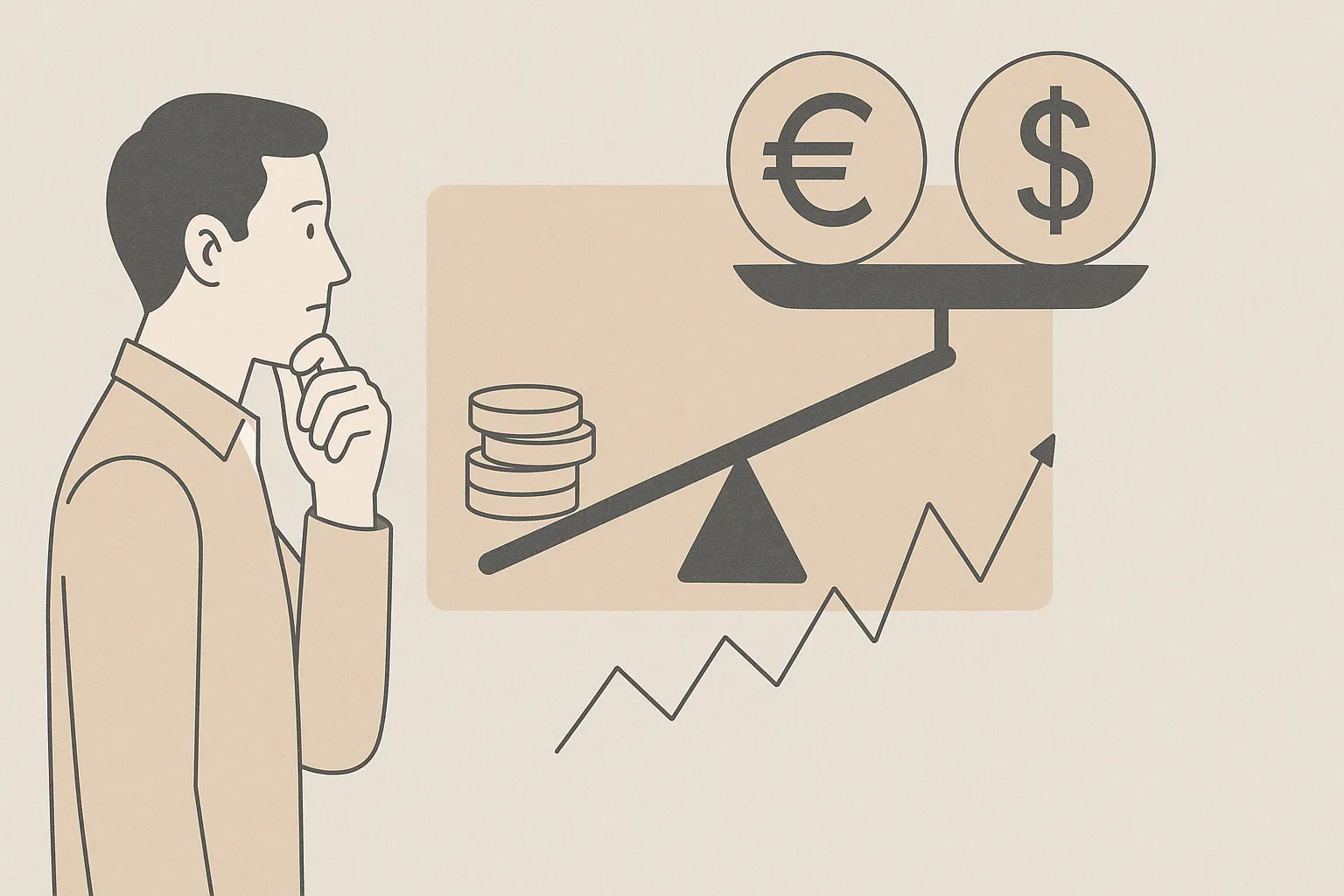
Leverage in forex trading is a powerful tool that allows traders to control positions much larger than their initial capital. It acts as a double-edged sword, offering the potential for magnified profits but also carrying the risk of equally magnified losses.
What Exactly is Leverage in Forex Trading?
In essence, it allows a trader to open a trade position significantly larger than the amount of money they actually have in their trading account. Think of it as a loan provided by your forex broker. For example, if a broker offers 1:100 leverage, it means that for every $1 of your own capital, you can control $100 worth of currency in the market. Without leverage, the capital required to make meaningful profits from the fractional price changes typical in forex would be prohibitively high for most individual traders. For more on the basics of forex, you can read our general guide to forex: https://axforexsignal.com/blog/forex.
How Does Leverage Mechanically Work in Forex? (Understanding Margin and Ratios)
Margin is the actual amount of your own capital that a broker requires you to deposit as collateral to open and maintain a leveraged position. It is not a fee or a transaction cost, but rather a good-faith deposit that ensures you can cover potential losses. The leverage ratio expresses the relationship between the total value of the position you can control and the margin required. For instance, a leverage ratio of 1:50 means that for every $1 of margin you put up, you can control $50 of currency. Conversely, this also means that the margin required is 1/50th (or 2%) of the total trade value. If you want to open a position worth $100,000 with 1:100 leverage, your required margin would be $1,000 ($100,000 / 100). The broker essentially lends you the remaining $99,000. The smaller the margin requirement (i.e., the higher the leverage), the more capital you can control, but also the more sensitive your account becomes to price fluctuations.
The Advantages of Using Leverage in Forex Trading (Potential for Higher Returns)
Without leverage, an individual trader might struggle to open positions large enough to make substantial profits from the typically small percentage price movements in currency pairs. By using leverage, traders can amplify their exposure to the market. For example, a 0.5% favourable movement on a $10,000 un-leveraged trade yields $50. The same 0.5% movement on a $100,000 leveraged trade (using $1,000 margin at 1:100 leverage) yields $500. Leverage can also free up capital, allowing traders to diversify their portfolio by taking multiple smaller positions across different currency pairs or instruments, rather than tying up all their funds in a single large trade. The ability to use leverage means that traders do not need a massive capital base to participate effectively in the global forex markets, thereby leveling the playing field to some extent.
The Significant Risks and Disadvantages of Leverage (Magnified Losses and Exposure)
Just as profits are amplified, so too are losses. A small adverse price movement, which might be negligible on an un-leveraged position, can quickly erode a substantial portion of a trader's capital when high leverage is employed. High leverage increases a trader's exposure to market risk; even a minor shift in sentiment or an unexpected economic release can lead to significant account drawdowns. Another critical risk is the potential for a margin call, where the broker demands additional funds to maintain an open position when losses deplete the account below the required margin level. Failure to meet a margin call can result in the automatic closure of positions by the broker, often at a loss. For context on managing risk, consider how stop-loss orders work: https://axforexsignal.com/blog/what-a-stop-loss-can-and-cannot-guarantee.
Essential Risk Management Strategies When Trading with Leverage
A stop-loss order automatically closes a position when the market reaches a predetermined price, limiting potential losses on a trade. Secondly, never risk more than a small percentage of your total trading capital on any single trade, typically 1-2%. Thirdly, avoid over-leveraging. While high leverage might seem appealing, conservative leverage ratios (e.g., 1:10 or 1:30) can provide sufficient exposure without exposing your account to excessive risk. Many experienced traders advocate for lower leverage to reduce the psychological stress and potential for magnified losses. Fourthly, maintain adequate free margin. Always have enough available capital in your account to absorb potential drawdowns without triggering a margin call. Fifthly, continuous education and market analysis are key. Understanding market fundamentals, technical analysis, and the impact of economic news helps in making informed trading decisions and avoiding impulsive, high-risk trades. An understanding of trading costs, including slippage, is also vital for risk management: https://axforexsignal.com/blog/trading-costs-spread-commission-financing-and-slippage.
Choosing the Optimal Leverage Ratio for Your Trading Style and Capital
As experience grows and understanding of market dynamics deepens, some traders may gradually increase leverage. Your trading style also plays a significant role. Day traders or scalpers, who aim for numerous small gains and often have tight stop-loss orders, might use higher leverage to capitalize on tiny price movements. However, swing traders or position traders, who hold trades for longer periods and thus expose their positions to larger potential market swings, typically opt for lower leverage to provide more breathing room for their positions. The amount of capital you have available also impacts this decision. A larger trading account may allow you to use lower leverage proportionally while still opening substantial positions. Conversely, a smaller account might necessitate higher leverage to achieve meaningful exposure, but this should always be balanced with strict risk management. Ultimately, the optimal leverage ratio is one that allows you to pursue your trading goals without exceeding your comfortable risk parameters, ensuring that a single losing trade does not significantly impair your trading capital. Regular review and adjustment of your leverage settings based on your performance and market conditions are also prudent.
Leverage, Margin, and Understanding Margin Calls
As discussed, margin is the capital required to open a leveraged position. It functions as collateral. Your broker continuously monitors the equity in your trading account relative to the margin required to keep your open positions active. Free margin refers to the amount of equity in your account that is not currently being used as margin for open positions and is available to open new trades or absorb losses. When the market moves against your open position, the floating loss reduces your account equity. If your account equity falls below a certain percentage of the margin required to maintain your open positions (known as the margin level), your broker will issue a margin call. This is essentially a notification that you need to deposit additional funds into your account to bring your margin level back above the required threshold. Failure to meet a margin call promptly will lead to a stop-out, where the broker automatically closes your open positions, usually starting with the largest losing ones, to prevent your account balance from going into negative territory. This automatic liquidation is designed to protect both the trader from accumulating debt beyond their deposit and the broker from lending unrecoverable funds. A margin call is a critical warning sign that your current leverage and risk management might be insufficient or that your trades are performing poorly. Preventing margin calls requires maintaining sufficient free margin, using appropriate leverage, and setting effective stop-loss orders to limit potential losses before they trigger such a drastic event. The trading platform you use will display your margin levels, so knowing how to interpret these is vital: https://axforexsignal.com/blog/fx-trading-platform or https://axforexsignal.com/blog/trading-platforms.
Integrating Leverage Wisely with Forex Signals and Trading Strategies
Leverage, when used judiciously, can enhance the efficacy of forex signals and various trading strategies. Forex signals, which are trade suggestions provided by third parties or generated by automated systems, often indicate entry points, exit points (take-profit), and stop-loss levels. Integrating leverage with these signals responsibly means using a leverage ratio that aligns with the signal provider's recommended risk per trade, if available, or your own established risk management parameters. Instead, analyze each signal in the context of your overall risk budget and the potential volatility of the currency pair involved. For instance, if a signal suggests trading a highly volatile pair during a major news event, a lower leverage might be more appropriate, even if the signal itself looks promising. Conversely, for signals on more stable pairs or during calmer market conditions, you might use slightly higher leverage, always within your comfort zone. Leverage can amplify the gains from accurate signals, but it will also amplify losses from inaccurate ones. Leverage should be viewed as a tool to optimize trade size within your risk constraints, not as a shortcut to immense wealth. Understanding what a trading signal is and how to use it is foundational: https://axforexsignal.com/blog/what-a-trading-signal-is.
Key Takeaways: Mastering Leverage for Informed Forex Trading
Mastering leverage in forex trading is about understanding its dual nature: a potent tool for magnifying potential profits and an equally dangerous instrument for amplifying losses. It is not an inherently good or bad mechanism but rather a neutral one whose outcome depends entirely on how it is wielded. However, this power comes with the critical responsibility of rigorous risk management, including the consistent application of stop-loss orders, careful position sizing, and maintaining conservative leverage ratios. Avoiding over-leveraging and understanding the mechanics of margin and margin calls are fundamental to protecting your trading capital. Finally, integrating leverage wisely with forex signals and your overall trading strategy means aligning its use with your risk tolerance and market analysis, rather than viewing it as a standalone strategy for quick gains. By approaching leverage with knowledge, discipline, and a commitment to risk management, traders can harness its power effectively, turning it into a valuable asset in their forex trading journey.